Fortnite players revolt against Steal The Brainrot’s V-Bucks system, slamming its gambling mechanics as a predatory cash grab.
Epic recently allowed UEFN creators to use in-game monetization to sell items within their maps in exchange for V-Bucks – yup, real money. The trend that had haunted Roblox in the past as it battled with games that scammed its player bases in exchange for Robux, has now entered Fortnite, and the game’s biggest UEFN map to date, Steal the Brainrot, was the first to implement it.
Since its loyal player base continues to enjoy the free offerings, the in-game items and structure after the latest UEFN update portrays a predatory monetary practice as players pushed back against its gambling system.
Fortnite’s Steal the Brainrot Adds Gambling-Style System After Latest UEFN Update, Sparks Player Outrage
Fortnite’s Steal the Brainrot introduces a gambling-style V-Bucks mechanic following the latest UEFN update, igniting widespread player backlash over perceived monetization excess and intrusive risk-like behavior within the game’s economy.
Fortnite’s Steal the Brainrot map is a replica of the infamous Roblox title Steal a Brainrot. Both games have been highly successful on each of the UGC platforms, pulling in huge numbers. While some may argue that about Fortnite, the UEFN map alone has been responsible for half of the Battle Royale title’s player count each day, with the game reaching a new all-time peak of over 1 million concurrent players last night.
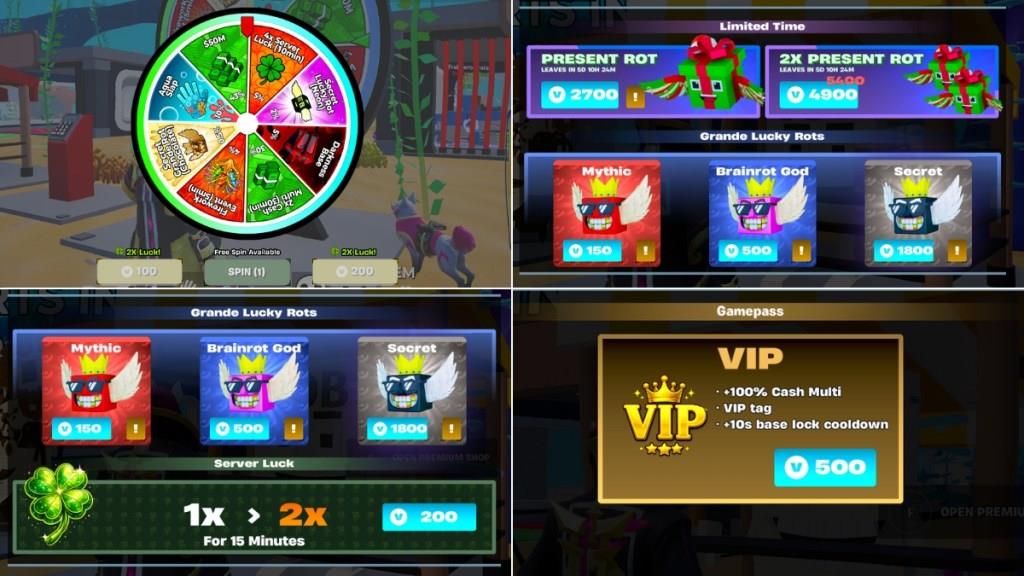
However, after the latest 39.20 UEFN update, Steal the Brainrot added V-Bucks to each of its shop items, as well as to its spin wheel, which many players on social media are Twitter The wheel grants 1 free spin to players every 4 hours. For each additional spin, you’ll need to spend 100 V-Bucks (around $0.99), and for 3 lucky spins, you’ll need to spend 200 V-Bucks (around $1.99).
This is because Epic informed creators that any purchases made in UEFN maps using V-Bucks will result in creators being paid a 100% share for those purchases. Which means if you spent $10 on an in-game item, the UEFN creator will get paid in full for that particular item, and Epic won’t get any cut.
But that’s not the real kicker – the game also features a limited-time shop which sells a brainrot for 2,700 V-Bucks ($18.99) and a 2x brainrot present for 4,900 V-Bucks ($35.99), and that’s an item that can be stolen any time from your base and is not a permanent item. This means if you choose to spend your real money and buy an in-game item in this map, it can be removed at the creator’s discretion and has no real usage in Battle Royale mode in Fortnite.
As soon as the community realised this, they blasted the game on social media, where one UEFN creator wrote, “Super disappointed in the Brain Rot guys… You make us all look bad with this kind of stuff.” Another player chimed in, “They better remove gambling and the ridiculous 4,900 V-Bucks purchase on a f**king creative map. Epic should cap them at 1,000 V-Bucks maximum.”
However, last night the map suddenly got Twitter, and the experience went offline due to a bug, sparking panic across the player base. Players who bought items during that time were worried about getting scammed as they were skeptical about the map’s return. Soon, the map’s dev team issued an update that they were trying to get it back up, and players who spent their V-Bucks right before the map went down will be refunded in full.
Just under six hours later, the map was back online, and as we noticed, nothing had been changed inside the map, except the thumbnail. While Epic continues to list Steal the Brainrot in its top Discover row, players are hoping other UEFN maps won’t follow this trend, as the ecosystem’s future seems to be in a bit of turmoil.
How do Fortnite’s UEFN monetization rules work
Fortnite’s UEFN monetization rules allow creators to earn revenue through engagement payouts and, since late 2025, in-island transactions using V-Bucks.
Engagement Payouts
Creators receive a share of Fortnite’s net revenue from Item Shop sales and real-money purchases, distributed proportionally based on player engagement metrics like popularity and retention time in their islands. Payouts occur monthly and vary with overall Fortnite revenue, without fixed per-player rates to account for fluctuating pots.
In-Island Transactions
Enabled starting December 2025 for UEFN maps, these let creators sell digital items (defined as Verse entitlements) directly in-game, such as cosmetics or boosts similar to Item Shop offerings-but excluding outfits, emotes, and certain vehicles. Prices range from 50 to 5,000 V-Bucks; randomized items like loot boxes require odds disclosure via specific Verse functions.
Revenue Share
Creators get 100% of V-Bucks value from transactions through the end of 2026 (dropping to 50% afterward), paid alongside engagement payouts after Epic deducts platform fees (averaging 26%, from 12% on Epic Store to 30% on consoles). V-Bucks value converts to USD based on monthly real-money spending data.
How are engagement payouts calculated month to month
Fortnite’s engagement payouts for UEFN creators are calculated monthly based on player interaction metrics from eligible islands.
Key Metrics
Payouts draw from Fortnite’s net revenue pool (after platform fees from Item Shop sales and real-money V-Bucks purchases), distributed proportionally to islands’ share of total player engagement. Engagement factors include playtime, retention, popularity scores, and user acquisition rewards, weighted to favor quality over raw visits.
Monthly Process
Epic aggregates data for the prior month, applies an updated formula (refined in late 2025), and issues payouts around the following month-often with estimates available via Creator Dashboard tools showing variance for recent days. Amounts fluctuate with overall Fortnite revenue, so top islands like “Steal the Brainrot” earn significantly more during peaks.