Molten metal, rare minerals, and a spark of strategy-ore recycling in The Forge isn’t just about smelting scraps; it’s about mastering the game’s hidden economy where every fragment can fuel your next powerful creation.
How Can You Recycle Ores in The Forge
Recycling ores in The Forge involves melting unwanted or excess ore pieces back into raw materials that can be reused for crafting. Place the ores into the forge’s melting chamber, then select the recycling option from the menu once the temperature reaches the required level. The system converts the melted ore into reusable ingots or fragments, which are then stored in your inventory. This process helps conserve resources and keeps your storage organized for future projects.
Players can recycle ores in The Forge by talking to the Marbles NPC in the Stonewake’s Cross or the Wo NPC in the Forgotten Kingdom and Frostspire Expanse. These are the major locations in The Forge, where you can sell crafted equipment or recycle it.

You can only recycle your crafted armors and weapons. And doing so will return you half the amount of ores used to craft that equipment. For example, if you have crafted a Straight Sword using six ores (2 Yeti Heart, 2 Void Star, 2 Snowite), you’ll get 3 of them back (1 Yeti Heart, 1 Void Star, 1 Snowite). However, if you are recycling equipment in which you have used one ore of each rarity; you’ll get back all the ores you’ve used. This happens only when you’re recycling Daggers, which typically require three ores.
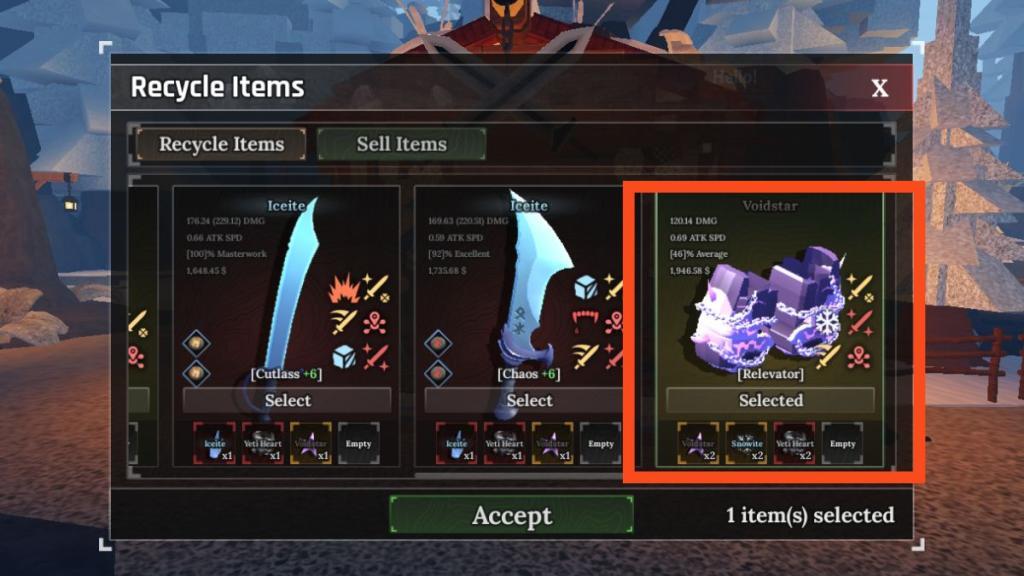
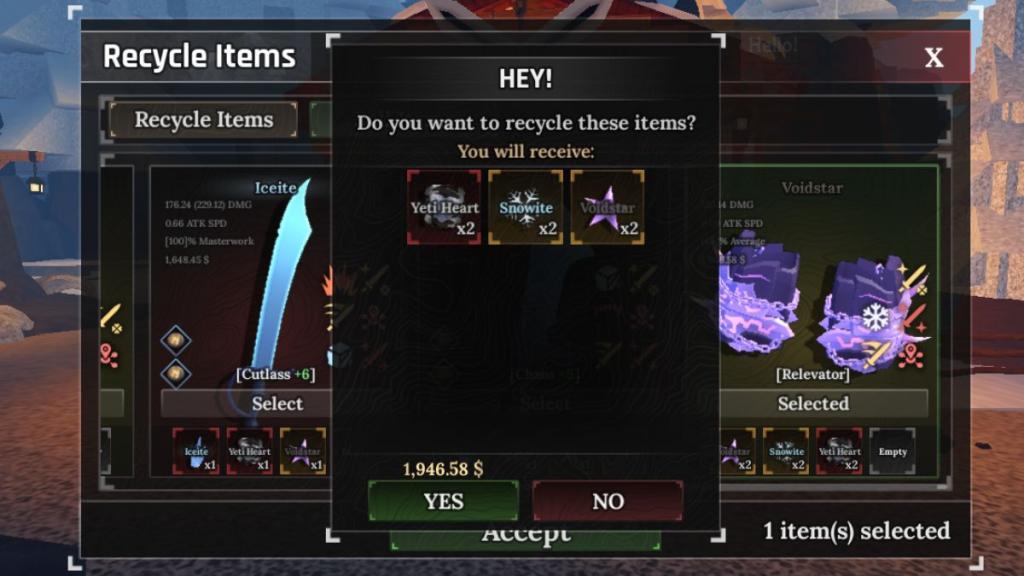

You’ll also need to spend a certain amount of money in order to recycle your desired equipment and get its ores. The amount of money needed depends on the selling value of the piece. The rarer the armor recipe or weapon recipe, the more money you need to recycle the ores. Lastly, don’t forget to free some bag space when recycling ores in The Forge. If your storage is full, you won’t receive the ores you’ve recycled.
Should You Recycle Ores in The Forge?
Recycling ores in The Forge can save both time and resources, especially if you often refine materials for crafting or trading. By reprocessing unused or low-value ores, players can recover useful metals or alloys without constant mining. However, recycling also consumes energy and may yield less material than fresh refining, so it’s best used when resources are limited or storage is full. Balancing recycling with regular gathering helps maintain a steady supply of materials for your in-game projects.
Yes, you should definitely recycle your ores in The Forge. This can be very useful to get back the Mythic, Relic, and Divine rarity ores, which you’ve used to craft weapons and armors. We recommend that you always recycle your weapons that you don’t need anymore instead of selling them.
Weapons like Straight Sword, Gauntlets, Spears, and Axes don’t yield a lot of money, so selling them isn’t worth it. This means you need less money to recycle them. These weapons often require some of the rarest ores to craft, which increases their damage by a lot. However, due to the sheer amount of RNG, you might not end up getting the weapon you want. Instead of storing or selling them, it’s better to recycle the ores.
Also Read: All Blueprints in The Forge and How to Get Them
On the other hand, getting armors are pretty easy as there are only a few types of the best ones. Given that you are going for Heavy Armors, they yield a lot of money when sold. Hence, you also require a lot of money to recycle them.
If you are a late-game player, then recycling might be your best option, as you might know how to make money fast in The Forge. But for early to mid-game players, it’s better if you avoid recycling ores until you’ve reached the late-game and obtained one of the best pickaxes.
What are the best items to recycle for maximum ore efficiency
For ore efficiency in The Forge, you want to recycle items that:
-
Use rare ores in small total quantities
-
Return close to (or exactly) their full ore cost when recycled (dagger “1-1-1” recipes)
-
Are cheap in gold compared to the value of the ores inside
Since I can’t fetch fresh in-game tables right now, treat the points below as principles rather than an exact tier list.
1. One-of-each-ore daggers (top priority)
Daggers that use exactly 1 of each ore type in the recipe (for example: 1 common, 1 rare, 1 mythic) are usually the most ore-efficient to recycle, because:
-
You spend only 3 ores per craft.
-
Many of these recipes refund all 3 ores or very close to it when recycled, effectively letting you “reroll” stats almost for free in terms of ore.
-
The gold fee per recycle is low compared to the value of the mythic/relic ores you’re protecting.
If you want a concrete rule of thumb:
-
Craft the smallest dagger recipe that includes the high-rarity ore you care about.
-
Recycle and recraft that same dagger repeatedly until you get a good roll.
2. Low-cost weapons with mythic/relic ores
If there’s no good 1-1-1 dagger option for a specific ore, look for:
-
Weapons that use the fewest total ores while still including that rare ore (for example 2-2-2 swords instead of 4-4-4 greatswords).
-
Recipes where half-refund still returns at least 1 of each rare ore type; that keeps your mythic/relic loss per attempt low.
Bad choice: high-cost greatswords or armor that eat 4-6 of each rare ore; losing half of that each recycle drains you fast.
Better choice: cheaper swords or hammers that still tap into the same rare ore but with smaller stack sizes.
3. Avoid recycling these for “efficiency”
You can still recycle them if you just want mats back, but they’re inefficient if your goal is to maximize rolls per rare ore:
-
Pickaxes (if the system even allowed it) – you need them, and they often have bad ore-to-refund ratios.
-
Large armor sets with many ores in the recipe – the 50% refund hurts more as total cost rises.
-
Any item where recycling fails to return even 1 unit of your key ore type on average.
A quick mental check:
-
If one recycle attempt “burns” 2+ of your best ore, stop and swap to a cheaper recipe.
4. Practical recyc
How to set up an efficient LDS recycling loop
You’re talking about the Factorio “LDS shuffle” / LDS recycling loop for quality, so I’ll describe a clean, efficient setup conceptually.
Core idea
You make Low Density Structures (LDS) with high-quality plastic as the only solid ingredient; LDS then gets recycled back into plastic (plus some copper/steel), and you repeat. The loop keeps rolling quality until you have lots of legendary plastic and LDS.
1. Production side (make LDS)
-
Set up a foundry (or assemblers) that craft LDS using:
-
Plastic bars on a dedicated belt (this is what you care about for quality).
-
Copper and steel fed by fluid casting or other sources, ideally as fluids so they don’t interfere with the quality loop.
-
-
Put productivity modules in LDS producers to maximize total LDS output.
-
Make sure all LDS output from this block goes into:
-
A buffer chest (for keeping good/legendary LDS).
-
The recycling loop (for low-quality LDS).
-
Principle: solid plastic carries quality, so LDS inherits that; copper/steel as fluids don’t “dilute” your quality chain.
2. Recycling side (turn LDS back into inputs)
-
Feed low-quality LDS into recyclers that have quality modules.
-
Route recycler outputs:
-
Plastic bars back onto the LDS plastic belt.
-
Any copper/steel plates either:
-
Back into casting (if you want a closed loop), or
-
Onto separate belts for general factory use.
-
-
-
Filter or sort by quality:
-
Normal / low LDS → back into recyclers.
-
High / legendary LDS → to a separate buffer for use in rockets, science, etc.
-
Principle: recycling gives you multiple rolls on quality for both plastic and LDS, amplifying the amount of high-quality material without more oil.
3. Controlling the loop so it doesn’t run forever
To avoid infinite, pointless recycling:
-
Put buffer limits:
-
Requester chest feeding recyclers: “Only request low-quality LDS up to X stacks.”
-
Provider chest for plastic: limit so plastic backs up on belt and pauses recycling naturally.
-
-
Add belt priorities:
-
Main plastic supply from oil has priority onto the LDS belt.
-
Recycled plastic only fills when there’s room; if the belt is full, LDS recycling slows or stops.
-
-
Optionally, use circuit conditions:
-
Enable LDS input to recyclers only if plastic < target amount.
-
Disable the loop if LDS or plastic storage exceeds a set threshold.
-
Principle: the loop should kick in when you need more quality plastic/LDS, and idle when belts/chests are full.