A YouTuber conjures a Minecraft ghast that fires blazing orbs, steering it with a custom drone to redefine what “mob” means in the game.
And once you encounter them in the game, you might think of running away when you don’t have the proper gear. However, YouTuber Electo dares to take things to the next level and create a real life Ghast.
YouTuber Builds a Flying Ghast That Breathes Fire
A YouTuber builds a lifelike flying ghast that breathes fire, blending robotics, drones, and Minecraft-inspired imagination to create a mesmerizing, playable projection of the famous in-game specter.
The content creator Electo has spent weeks in engineering what he calls the “world’s first working Ghast.” But, some of you might wonder how all of this works, and the answer is quite simple – using a custom-made drone and some flash paper.
The initial body of the Ghast was made using Balsa wood; however, the frame became fragile to hold up. So, Electo had to switch to a sturdier and more lightweight wood- the foam boards. Next up, tentacles were added to the mob and designed in such a way that they won’t fall apart when the Ghast lands on the ground.
Also Read: Minecraft Copper Golem Statue Guide: How to Get, Oxidation, and Redstone
Now, the Minecraft Ghast was ready for its flight; however, an important aspect of the mob was still not added: the fireball launcher. Electo developed this launcher using flash paper and flash cotton materials, which are commonly used for safe fire effects. After lots of tests and a few close calls, the entire system was perfect and the Ghast was able to ignite and launch fireballs before burning down.
Although a few early prototypes weren’t smooth and parts of the drone broke due to unstable flights. At times, Electo turned to AI for fine-tuning the drone settings too. Once everything was once again upgraded, including the propellers, wiring and airflow design, the Ghast was finally able to complete its first flight safely. And yes, the fireballs we launched perfectly as well.
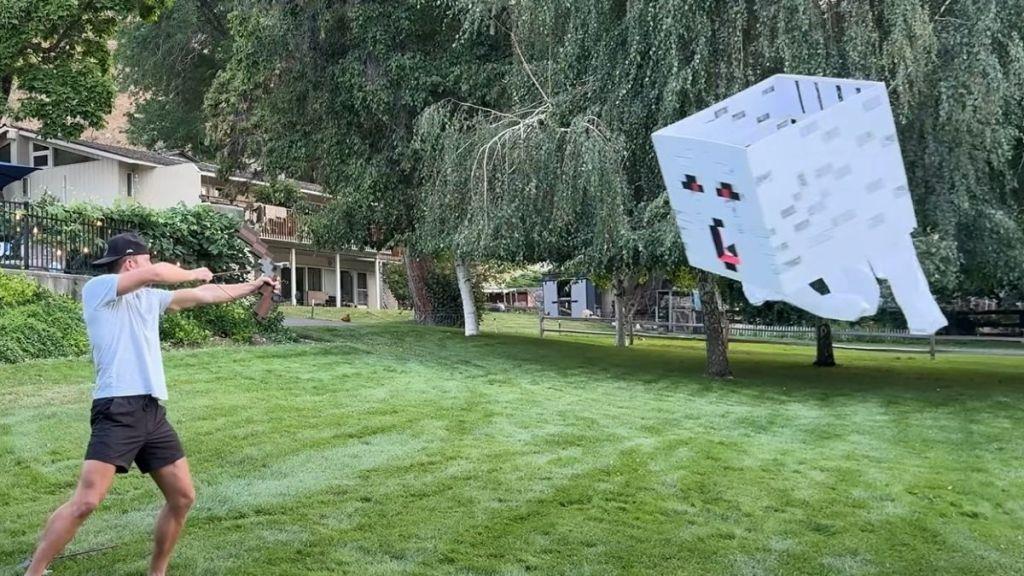
So, the final creation was named Gary the Ghast, which featured swinging tentacles, detailed textures that resembled the pale Nether mob, and a quad-barrel fireball system. In the end, Electo staged a battle between Gary and his brother that resulted in fiery chaos.
How did Electo make the fireball mechanism
Electo crafted the fireball mechanism for his Minecraft Ghast drone using flash cotton ignited by a nichrome wire coil.
Mechanism Design
Flash cotton, a highly flammable material that burns rapidly without sustained flame, served as the fireball material to mimic the game’s explosive projectiles. A nichrome coil heated up to ignite the cotton precisely when triggered, propelling small bursts forward through a quad-barrel launcher mounted on the drone’s underbelly.
Testing and Safety
Electo conducted numerous ground tests to calibrate ignition timing and trajectory, addressing issues like misfires and excessive smoke by refining the coil voltage and cotton packing density. Safety measures included remote activation, fire-resistant materials around the launcher, and controlled outdoor flights to prevent uncontrolled burns.
What voltage and pressure create plasma fireballs
Plasma fireballs form in laboratory settings through gas discharge when a positively biased electrode in a low-pressure background plasma reaches specific voltage and pressure thresholds.
Key Parameters
Typical conditions include electrode voltages of 30-100 V, often around 50-70 V, applied to a small electrode (e.g., 1 cm diameter) in gases like argon or neon. Pressures range from 10^{-3} to 10 mTorr (about 0.001-0.01 mbar), creating a weakly ionized plasma where a double layer forms, accelerating electrons to ignite the luminous fireball.
Formation Process
At these levels, a luminous sheath expands abruptly into the fireball, sustained by electron-neutral collisions and instabilities, with durations of microseconds in pulsed setups. Variations depend on gas type, electrode geometry, and background density, but higher pressures or voltages favor stability up to ~100 V at a few mTorr.
