A spark in the dust reveals a shard of weathered metal, and suddenly your world is charged with a silent threat and a plan to tame it.
Items Required to Craft a Lightning Rod in Minecraft
Items required to craft a Lightning Rod in Minecraft include three copper ingots, one lightning rod core (copper rod), and a smooth surface or an anvil for assembly, with crafting arrangements confirming the correct shape to place the ingots around the central copper rod.
The crafting recipe of the lightning rod requires only 3 copper ingots. In order to obtain copper ingots, you will first need to mine a few copper ores in the overworld. Mining copper ores gives you access to raw copper, which you can later melt in a furnace to get copper ingots.
Apart from these, you need a crafting table, on which you can place the required ingredients to get the lightning rod.
How to Make a Lightning Rod in Minecraft
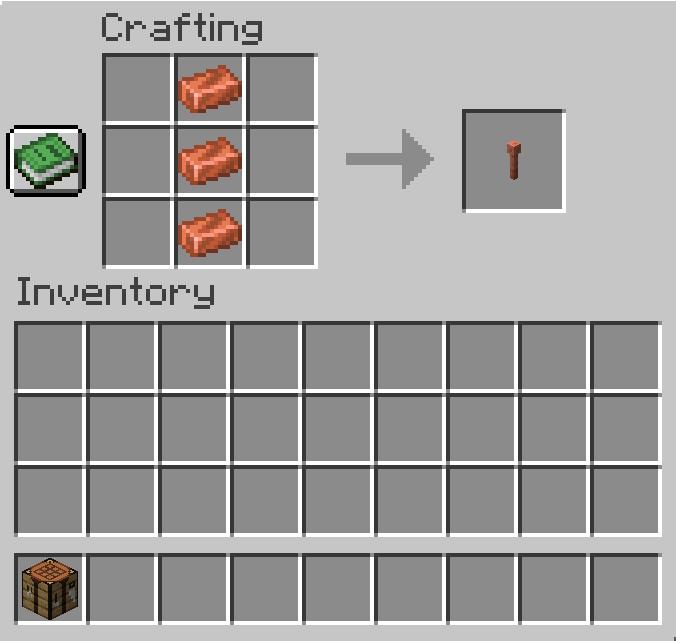
A lightning rod in Minecraft is crafted using three copper ingots placed vertically in the center column of the crafting grid. Once crafted, you can place the rod on any solid block, usually on rooftops or tall structures. It helps direct lightning strikes to a specific spot, protecting flammable buildings like wooden houses from fire damage during thunderstorms.
Now that all the materials are in hand, you may follow the given steps below to craft a lightning rod:
- Place and right-click on the crafting table to open its UI.
- Now fill the center column of the 3×3 grid with three copper ingots.
- The lightning rod will appear in the right cell in the crafting table.
- You can collect it by dragging and dropping it into your inventory.
Also Read: How to Make and Use Shelf in Minecraft
How to Use a Lightning Rod in Minecraft
Place the lightning rod on top of a structure during a thunderstorm to safely attract and redirect lightning strikes away from your builds. It prevents fires from spreading in wooden areas and stops creeper charges nearby. Right-click the block with a tool to check if it’s channeling lightning, and combine it with copper blocks for decoration. This keeps your base secure while harnessing storm power for channels like trident enchantments.
The lightning rod can be placed anywhere on the ground or any solid surface. In order to pick up a lightning rod, you will need to break it using a pickaxe. One of the unique features of the rod is that it’s transparent in nature, which means mobs can pass through it at any time. That said, check out the uses of the lightning rod in Minecraft:
1. Redirecting Lightning
A lightning rod, when placed on a surface, can redirect lightning to itself during a thunderstorm or when hit by a Trident with the channeling enchantment. Moreover, in the Bedrock edition, as long as the rod has a transparent block directly on top of it, it will receive lightning strikes.
You can use this feature of the lightning rod to get mob heads in Minecraft. Simply make a chamber with a lightning rod to get charged creepers, and then explode them near the mob whose head you wish to add to your collection.
2. Redstone Mechanics
As you might know, copper conducts electricity in real life. Similarly, the lightning rod works with Redstone in Minecraft to conduct signals. The lightning rod can emit a Redstone signal as high as 15 when struck by lightning during a thunderstorm. This is the same Redstone signal strength emitted by a Redstone torch as well.
However, the only disadvantage is that it won’t work if there is no thunderstorm. Moreover, when the lightning strikes the rod, the signal will stay for just 8 game ticks, which won’t be fruitful for making structures that require continuous Redstone signals. So, you may use lightning rods in making a detector that lights up when a thunderstorm occurs in the game.
3. Oxidative States of Lightning Rod
The above given recipe will always give you a rusty orange color, a completely unoxidized lightning rod. Moreover, in the current stable game drops of Minecraft, you won’t find any oxidations on the lightning rod as well. This will be changed in the Minecraft Fall drop, and we will update this page accordingly.
From the Minecraft snapshots that came out recently, the lightning rod has 4 oxidative states, similar to other copper blocks. So, with time, the lightning rod becomes greener as it transforms to an oxidized rod. You may still remove its patina by scraping off using an axe.
Best places to place lightning rods in a base
Lightning rods in Minecraft protect bases from lightning strikes during thunderstorms by redirecting them to a safe spot. Place them at the highest points of your base or nearby towers for optimal coverage within a 128-block radius (Java Edition) or 64-block radius (Bedrock Edition).
Optimal Locations
Mount lightning rods on tall towers made of non-flammable blocks like stone or copper, positioned higher than surrounding structures to intercept strikes first. Keep them at least 5 blocks away from wooden or flammable areas to avoid fire spread from the 5×5 impact zone.
Coverage Strategy
-
Position one centrally above large bases for broad protection, or space multiples every 100-120 blocks for full coverage.
-
Place on rooftops of key buildings like farms or villager trading halls, elevated on pillars to shield villagers from witch transformations.
-
Use ground-level rods next to (but not touching) the base perimeter to divert strikes away entirely.
Additional Tips
Elevate rods to Y-level 120 or below for reliable attraction without excessive height. They emit a redstone signal on strike, so integrate with farms or alarms, and deoxidize nearby copper blocks as a bonus.
How far should lightning rods be from base structures
Lightning rods in Minecraft should stay at least 3-5 blocks away from wooden or flammable base structures to prevent fire spread from the lightning impact zone. This buffer ensures the strike hits the rod safely without igniting nearby blocks.
Safe Distance Guidelines
Maintain a minimum of 3 blocks horizontally from the rod’s base to wooden roofs or walls, as players report success with this spacing on stone pillars. Increase to 4-5 blocks for extra caution, especially in Bedrock Edition with its smaller 64-block protection radius.
Strategic Positioning
Place rods on elevated towers (10+ blocks high) outside the base perimeter, ensuring the rod sits higher than any structure within the 128-block (Java) or 64-block (Bedrock) radius. Ground-level rods next to the base work if spaced 5+ blocks away to divert strikes entirely.
Risk Factors
Avoid placing rods directly atop flammable builds; the 5×5 ground-level impact area can still ignite blocks if too close. Test in creative mode and use non-flammable surroundings like stone or copper for the rod’s support.
